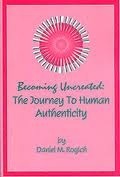
Becoming Uncreated:
The Journey to Human Authenticity
Updating the Spiritual Christology
of Gregory Palamas
by Daniel M. Rogich
Light & Life Publishing
1997
233 pages
We sometimes hear that the teaching of the Fathers of the Church is too abstract and not relevant to our 21st century daily life as Christians.
Even though Gregory Palamas died in 1357, rather late for the Fathers important in Orthodoxy, his works are mostly unknown from most English speaking lay people.
The fact that his major work, the Triads, is only now finally being accessible in English in its entirety certainly didn’t help. I was fortunate to grow up in France, and had easy access to Meyendorff’s bilingual Greek-French edition published back in 1959!
Thanks to Christopher Veniamin, Gregory’s Homilies have been available since 2002 in an excellent edition, and in smaller volumes more accessible to all wallets. Still, I don’t know many Orthodox parishioners who have read this book.
Hence the importance of Father Daniel M. Rogich’s book Becoming Uncreated:
The Journey to Human Authenticity and his worthy intention of “Updating the Spiritual Christology of Gregory Palamas”, to make it more relevant to our time.
However, this is not an easy book, and again, I’m not sure how many parishioners have read it, even though it is definitely not a recent book. In my parish, even though some members are very well read, no one except two of our priests have indeed read it, and one only after I pointed it out to him.
And seeing the difficulty of the book, I understand why.
It would be a wonderful book though to launch into, as at each page you may be invited to review some important theological terms and events, such as decisions and statements made at various ecumenical councils.
Alas, I don’t have the sharpness of an analytical mind to be able to do a proper review of this book.
I can only highlight what I think is the ultimate strength of this book.
I would say that distancing himself from popular critiques of highfalutin jargon sometimes attributed to Palamas, Rogich shows that Palamas’ christology is actually closely related to spirituality, in the sense that Gregory constantly makes references to saints’ daily lives and their experiential knowledge of Christ.
Another major line for Rogich, especially developed in the last part of the book, is to show how Palamas’ discourse is relevant today at many levels important for our time, such as quantum physics, psychotherapy, and dialogs with world religions.
In case you know nothing about Gregory’s life, suffice it to say that he had for instance very important dialogs with Muslim thinkers.
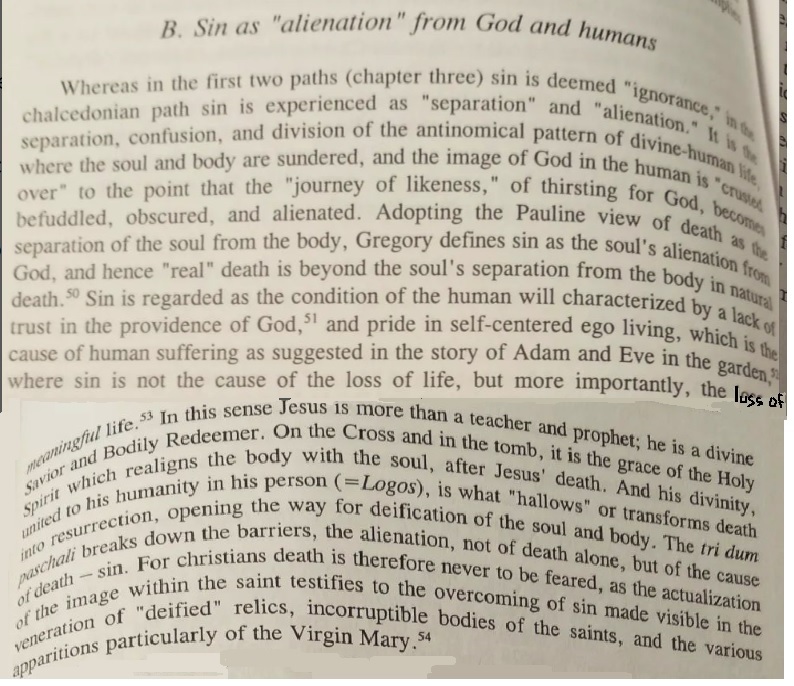
I would like to share an excerpt that I personally find so relevant to our times, where confusion and alienation are rampant.
It is also a powerful example of how Orthodoxy considers sin, not on the moral level, but more on the anthropological level. As others have stated it, sin is considered as a sickness, and the Orthodox Church is not a tribunal, but rather a hospital (see also Jean-Larchet’s amazing masterpiece Therapy of Spiritual Illnesses)
Ultimately, Rogich shows that Palamas’ multi-leveled thinking is totally appropriate to satisfy our contemporary thirst for meaning.
Palamas’ presentation of theosis/deification is indeed a way of how to become a saint, in other words, an authentic human being.
At the same time as this book, I have been reading Father John Behr’s John the Theologian and his Paschal Gospel, as well as Olivier Clément’s On Human Being.
It strikes me that coming from three different avenues all three authors converge to the same essential idea in Orthodoxy that reaching theosis is reaching the fullness of what it is to be a human being.
I can only encourage you to read Rogich’s book, which contains so much more that I have managed to convey.
VERDICT: Palamas’ Christology isn’t abstract but deeply personal, offering a path to authentic humanness through deification, just as relevant today as in the 14th century.
DID YOU READ THIS BOOK?
WHAT DID YOU THINK?
What’s your favorite book
to better understand Gregory Palamas?
DO YOU FEEL LIKE READING THIS BOOK?
SHARE YOUR THOUGHTS IN A COMMENT PLEASE


[…] Book review: Becoming Uncreated: The Journey to Human Authenticity – Updating the Spiritual Christology of Gregory […]
LikeLike
[…] Becoming uncreated: The journey to human authenticity: The Journey to Human Authenticity – Updating the Spiritual Christology of Gregory Palamas, by Daniel M. Rogich […]
LikeLike
[…] Becoming uncreated: The journey to human authenticity, by Daniel M. Rogich […]
LikeLike