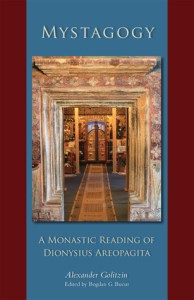
 Mystagogy:
A Monastic Reading of Dionysius Areopagita,
by Alexander Golitzin
Liturgical Press
2013
496 pages
Having read Dionysius Areopagita‘s works some time ago, I felt the need for a broader and recapitulating picture. A friend told me this was the best book on the topic, so I decided to read it. My friend was right. Mystagogy: A Monastic Reading of Dionysius Areopagita is one of those books that asks a lot of you, but gives a lot back.
Golitzin’s central argument is really quite elegant once you get hold of it: Dionysius the Areopagite has often been read as a kind of Christian philosopher, heavily influenced by Neoplatonism and a bit awkward to fit into the mainstream of the tradition.
Golitzin says no. He wants us to read Dionysius as a churchman, a monk, a mystagogue — someone writing from inside the life of liturgy and ascetic practice, not from the armchair of abstract speculation.
Mystagogy is actually a revised edition of Golitzin’s earlier book: Et introibo ad altare Dei (1994) with the incorporation of many articles written since by him on the same topic.
What I found most compelling is how Golitzin organizes the whole Dionysian corpus around the Ecclesiastical Hierarchy, treating it as the pivot of all his other works.
Hierarchy, on this reading, isn’t about church bureaucracy. It’s about sacred ordering — the way rites, symbols, and offices mediate divine life to human beings and draw them upward toward God. The Church at worship is where Dionysius’s theology becomes real and concrete.
The book moves through a clear arc: from the liturgical and ascetic context of Dionysius’s world, to the unity of the corpus, to the Incarnation as the foundation of all of it, to the soul’s eventual ascent into mystical union with God.
There’s a chapter on the Fall too, which matters — Golitzin wants you to understand why all this mediation is necessary in the first place. We are, as he puts it, “outside the doors,” and the Church’s hierarchy is the way back in.
But perhaps the move I found most interesting is what Golitzin does at the beginning and end of the book. He doesn’t present Dionysius as an isolated genius. He situates him inside a long line: Scripture first, then the Fathers before him, and then the later Orthodox authors who received and built on him.
The apocalyptic and visionary grammar of the Bible — throne visions, divine fire, heavenly ascent — is already present before Dionysius arrives. He’s not inventing a new mystical language; he’s giving a remarkably concentrated form to something already alive in the tradition. And after him, later Eastern writers continued to draw on him naturally, because he was already legible to them. He is, in a sense, both inherited and inherited from.
A word of honest warning: this book is dense.
There’s a lot of untranslated Greek, so it really helps if you can at least read the Greek alphabet. And of course, he uses close engagement with patristic sources, and prose that doesn’t slow down for the uninitiated.
If you’re new to Dionysius or to patristics generally, I would say this book is not for you.
But if you have some background in Eastern theology, liturgy, and the ascetic tradition, it’s genuinely rewarding — one of those books that changes the way you see a whole corner of Christian thought.
The simplest way I can put Golitzin’s thesis is this: Dionysius is not an anomaly. He is one especially luminous expression of a biblical, patristic, and monastic continuum — and once you see him that way, a lot suddenly starts to make sense.
MY VERDICT:
Dionysius Areopagita is not a philosophical oddity but a monk writing from inside the Church’s liturgical life — one luminous expression of a continuum that both precedes and follows him. Dense, but transformative for the right reader.
DID YOU READ THIS BOOK?
WHAT DID YOU THINK?
SHARE YOUR THOUGHTS IN A COMMENT PLEASE

