 On the Lord’s Prayer,
by Saint Maximos the Confessor
(c.580-662)
Possibly written around 628-630
Translated from the Greek
by Kallistos Ware,
G.E.H. Palmer, Philip Sherrard
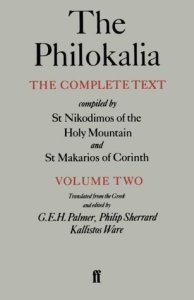
21 pages in this edition (cover):
Volume 2 of the Philokalia (1981, Faber and Faber)
Available here, among other places
On a regular basis, I meet online with one of our parishioners to discuss a book.
We recently finished Andrew Louth‘s book on Maximus the Confessor – I will soon share a few things on that.
It was a great overview on Maximos’s teaching, but very dense.
So we decided to read one more text by him, somewhat more accessible: his commentary on the Lord’s Prayer.
I have been reading and rereading this text for many years, but never took time to take notes.
I’m sharing them today, highlighting the structure of this wonderful text.
Notes on Maximos’s commentary on the Lord’s Prayer, part 1
Introduction pages 285-286 (in the edition mentioned above):
Good intro on human relationships: hope to find the right balance between fear and over-familiarity.
Shows then how fear helps keep intact the rule and practice of love.
Note “providence and judgment” that often come together in Maximos.
end of 1st paragraph, p.286
In this line of love, he accepted to write what the recipient asked for, on God’s will and counsels.
Hence a necessary commentary on the Our Father:
“If the purpose of the divine counsel is the deification of our nature, and the aim of divine thoughts is to supply the prerequisites of our life, it follows that we should both know and carry into effect the power of the Lord’s Prayer, and write about it in the proper way.”
beg. of 2nd parag., p.286
This prayer indeed contains the whole purpose and aim of deification. It also
“includes petitions for everything that the divine Logos effected through His self-emptying in the incarnation, and it teaches us to strive for those blessings of which the true provider is God the Father alone through the natural mediation of the Son in the Holy Spirit.”
Seven mysteries are hidden in this prayer:
listed in the 1st parag., p. 287
- Theology,
- adoption as sons by grace,
- equality with the angels,
- participation in eternal life,
- the restoration of human nature when it is reconciled dispassionately with itself,
- the abolition of the law of sin,
- and the destruction of the tyranny that holds us in its power through the deceit of the evil one.
Now he explains what he means by these seven mysteries, in the following 7 paragraphs.
It’s interesting to start seeing already how he will connect these 7 mysteries with the lines of the Lord’s Prayer, as he gets deeper later on:
- Theology:
Theology is taught us by the incarnate Logos of God, since He reveals in Himself the Father and the Holy Spirit. - Adoption as sons by grace:
The Logos bestows adoption on us when He grants us that birth and deification which, transcending nature, comes by grace from above through the Spirit.
Then preserving it depends
– on our resolve,
– on our practice of the commandments,
-“on their cultivation of the beauty given to them by grace”, (I like this phrase)
– and on our self-emptying, so basically on our imitation of Christ. - Equality with the angels:
“The Logos has made men equal to the angels”.
And “He united heaven and earth in Himself, joined what is sensible with what is intelligible (very common differentiation in Maximos), and revealed creation as a single whole whose extremes (also often found in his writings) are bound together through virtue and through knowledge of their first Cause. He shows, I think, through what He has accomplished mystically, that the Logos unites what is separated and that alienation from the Logos divides what is united.
Let us learn, then, to strive after the Logos through the practice of the virtues, so that we may be united not only with the angels through virtue, but also with God in spiritual knowledge through detachment from created things”. - Participation in eternal life:
“The Logos enables us to participate in divine life by making Himself our food”. - Restoration of human nature:
through the voluntary character of His Passion, through abolishing our sins, and “through reconciling us through Himself to the Father and to one another”. - Abolition of the law of sin:
By absence of sensual pleasure in His conception, and by freeing those who choose the same path. - Destruction of the tyranny of the evil one:
By his natural death in the flesh.
After the 7 paragraphs just mentioned, he recapitulates the seven mysteries in a paragraph (the 2nd page 189), where we get closer to the line by lin commentary.
The Lord’s Prayer contains a petition for each of these things:
- it speaks of the Father, His name, and His kingdom.
- It shows us that the person who prays is by grace the son of this Father.
- It asks that those in heaven and those on earth may be united in one will.
- It tells us to ask for our daily bread.
- It lays down that men should be reconciled with one another and unites our nature with itself when we forgive and are forgiven, for then it is not split asunder by differences of will and purpose.
- It teaches us to pray against entering into temptation, since this is the law of sin.
- And it exhorts in to ask for deliverance from the evil one.
It is called prayer, as “it contains petitions for the gifts that God gives to men by grace”.
Not a vow, which is a promise made by men.
Maximos has a long development (pp.289-290, with many Biblical references) on this difference between prayer and vow, probably because of the Pelagian heresy.
Next time, we will start looking at his explanations on the first lines of the Lord’s Prayer.
PLEASE SHARE YOUR THOUGHTS ABOUT THESE NOTES
Are you familiar with this short commentary on the Lord’s Prayer?

